

During the entire academic year of 2020/21, we faced the worst pandemic the world has experienced in the last 100 years. Nevertheless, the Technion maintained extensive research activity, expanded its tech-transfer operation, and continued executing its strategic plan toward stronger contracts with industry and lifelong learning.
Funded research
Research contracts signed in 2020/21 by the Research Authority amounted to $95M, a decline from the record of $108M in 2019/20 and $101.5M in 2018/19, and similar to the academic years prior to 2018/19. This is entirely due to a sharp decline in new contracts with the EU. There are two main reasons: The transition to the new EU Horizon Europe plan slowed down because of the pandemic, and Israel joined the Horizon Europe plan only in late 2021.
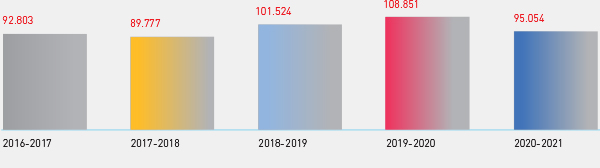
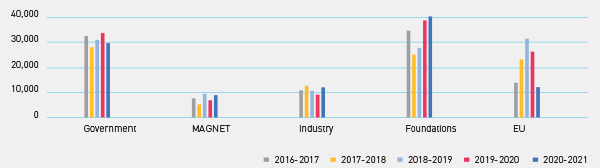
On the positive side, we had a strong performance in the Israel Science Foundation (ISF) grant competition. We also experienced growth in sponsored research agreements with industry. The number of government contracts declined because for political reasons the Israeli government operated without a regular budget through most of 2021.
In 2020/21, Technion researchers submitted 216 proposals to the ISF and won 73 grants, compared to 180 submissions and 69 grants in 2019/20, 192 submissions and 82 grants in 2018/19, and 64 grants out of 179 submissions in 2017/18. Overall, the success rate of Technion researchers in ISF competitions continues to be higher than the national rate. At the same time, we note a continuous increase in the total number of applications to ISF grants, and the competition is very stiff.
One of the highlights of 2020/21 was the signing of strategic industrial contracts. One contract was signed with PTC, a leading international company that develops and markets software for design and production, and another with the fast-growing renewable energy company Doral. The Technion was recognized during 2020/21 as a strategic partner of Intel.
The Technion continued to invest heavily in providing new faculty with optimal research infrastructure. Thus, in 2020/21 we invested 74.5M NIS in new faculty research allocations, compared to 70.5M NIS in 2019/20, and 74M NIS in 2018/19.
Challenges:
The main challenge we now face is the relations with EU grant agencies. The EU started its new Horizon Europe program during 2020/21. Israel only joined Horizon Europe in late 2021, and under inferior terms to what we had in previous programs. This might cause a reduction in the total number of grants available to Israeli scientists. On the positive side, at the beginning of the 2021/22 academic year we saw a substantial increase of new prestigious ERC grants awarded to Technion researchers.
External aid for research
In addition to the external funding mentioned above, in 2020/21, the Technion received contributions from donors for specific individual researchers, or the creation of research infrastructures for a total amount of $22.8M, compared to $12M in 2019/20, $13M in 2018/19, and $17.4M in 2017/18.
Challenges:
Donation grants tend to be focused on specific fields (e.g., healthcare) and are not available to the general population of PIs. To address this the Technion Research Directory was constructed in 2018,a searchable database of brief proposals submitted by Technion faculty and used to help donors find topics of interest.
COVID-19 research
Several Technion researchers continued their COVID-19 research well into 2020/21. Most notable was the sewage surveillance project led by Prof. Eran Friedler. Sewage samples were taken regularly from several manholes serving all Technion dormitories. Analyzing these samples on a regular basis identified all COVID-19 outbreaks at the dormitories. This enabled us to monitor the pandemic on the campus and cut all infection chains in our dorms.
International collaborations
Expanding scientific collaborations with institutes abroad is an important goal for the Technion. A major instance of such collaboration is our membership in the EuroTech Universities Alliance of six leading European technology schools that in addition to the Technion includes TUM (Munich), EPFL (Lausanne), DTU (Copenhagen), Ecole Polytechnique (Paris) and TU/e (Eindhoven). We are also members of CESAER, an international group of European schools of technology.
We have joint projects with the University of Michigan (together with the Weizmann Institute) and the University of Waterloo. Furthermore, we continued our long-term partnership with the Universities of Aachen and Julich. Joint research projects with Tokoshima University in Japan (along with Nichia Corp., who supported this collaboration) were carried out successfully despite the restrictions imposed by the pandemic.
We attribute great importance to collaboration with industry. We believe that industrial contracts contribute to both sides. The Technion enjoys support for research, better education for students and help in providing our faculty with up-to-date knowledge of emerging needs. On the other side, the Technion is committed to helping the Israeli industry and the country’s economy in general. A major obstacle that emerged in recent years was a dispute on IP ownership. We resolved this problem by creating flexible models for industrial contracts. Each company is encouraged to select its preferred model. Indeed, several new contracts were signed and several more were in progress during 2020 in a variety of areas. Initial signs of success of the new models were seen in 2020/21. In addition to the strategic partnerships mentioned above, total industrial contracts in 2020/21 amounted to $12.3M, compared to $9.5M in 2019/20 and $10.7M in 2018/19. We are pleased to see a further increase in industrial collaboration well into 2021/22.
Challenges:
Obtaining industrial contracts requires continuous proactivity of our staff in approaching potential companies. One of our goals is to make the Technion a hub for traditional industry, including food and pharma.
Pre-clinical research
The pre-clinical research authority is a complex operation providing animal research facilities to faculty members of the Technion and affiliated hospitals and to commercial companies at two separate locations, one at the Medical School and one on the main Technion grounds.
In 2020/2021, the research authority continued to implement its development plan, including a new budget structure, new infrastructure, and improved service to commercial entities that use our facility. The TRDF supported the authority through its Research Fund. The support included buying a new imaging device and financing the preparations toward obtaining the AALAC certificate.
Translation of research
Translation of knowledge is handled by the Technion Technology Transfer (T3) Office, a division of the Technion Research and Development Foundation (TRDF), Ltd.TRDF is a for-profit company owned by the Technion, and the Technion Executive Vice President for Research serves as the CEO of TRDF.Income from licenses and royalties plays a vital role in supporting research at the Technion, including purchasing research infrastructure. We emphasize the commercialization of scientific discoveries to foster an ecosystem of innovation and entrepreneurship at the campus. Furthermore, the Technion sees translation of knowledge as an important contribution to the State of Israel.
Following a complete remodeling during 2018/19 and 2019/20, the T3 unit showed impressive results in 2019/20 and much more in 2020/21.
A few new models for commercialization were launched or expanded during 2020/21, under the general philosophy that different approaches are needed for different disciplines. This includes the expansion of the Purple Lane, where faculty members are given the right to pursue their know-how to form new ventures in cases where no patents were filed or granted, and no extensive use of Technion resources was made.
A total of 136 new patents were approved during 2020/21. The Technion was again the leading university in Israel and second in Europe, in approved US patents. This helped increase our patent portfolio to 740 families, compared to 715 families in the previous year, 635 in 2018/19, and 550 families in 2017/18.
A total of 57 new commercialization contracts were signed during 2020/21. Twelve spinoff companies were launched by Technion researchers, compared to 14 spinoffs in 2019/20, 6 companies in 2018/19, and a similar number in 2017/18. We expect an even larger number of new spinoffs in 2021/22.
The significant increase in our deal flow is now reflected in the total holdings of the Technion, reaching over 130 companies in diverse areas. To illustrate this, we mention some of the most successful private spinoffs: Aleph Farms (cultured meat), Xact Robotics (medical devices), Starkware (software), H2Pro (hydrogen production), Tabnine (software), Qedma (quantum computing), Canasoul (cannabis), Cytoreason (bioinformatics), Deci.AI (software), Speedata (chip design), Luminiscent (energy), and Tamar Robotics (medical devices).
The T3 unit launched its new website in 2020/21, which includes information on over 340 Technion technologies, the labs of over 300 faculty members, over 120 spinoff companies founded in recent years and many success stories.
The TRDF recognizes the importance of investments in research infrastructure. In 2019/20, we established a new internal fund for this purpose. In 2020/21, we invested 8M NIS in this fund, compared to 6M NIS in 2019/20. The fund was used to match outside grants (VATAT and ISF) to support the pre-clinical authority, to support the Technion High Performance Computing center, and certain specific projects of groups of faculty members. This fund is fully financed by our success in commercializing Technion technologies.