
First lens fabricated in space using method developed at the Technion – Technion’s Nano Bible travels to the International Space Station – Physicists to explore gamma ray bursts in space
Space is the next frontier for humanity, and Technion researchers play a critical role in making that possible by expanding our knowledge of the universe with their technological and scientific breakthroughs.
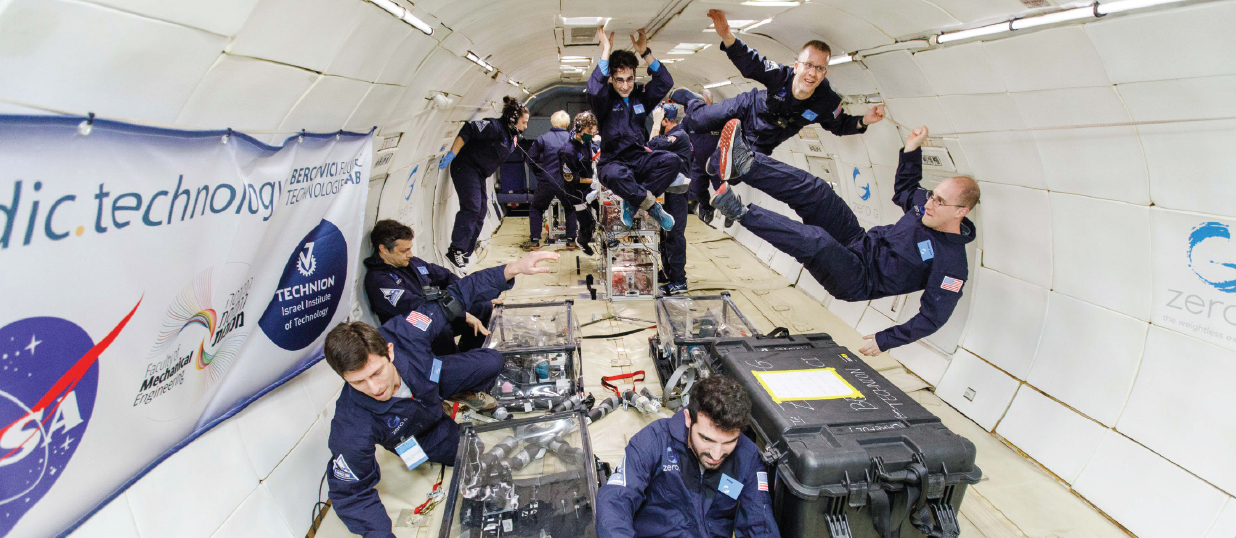
One of the Technion’s most recent achievements in this field was the fabrication of the first-ever lens in space – an experiment that was performed in close collaboration with NASA. Using the Fluidic Shaping Method developed by Prof. Moran Bercovici’s lab at the Faculty of Mechanical Engineering, the development of space telescopes could be revolutionized.
Space telescopes are essential for our fundamental understanding of the universe. The largest telescopes available today are several meters in diameter, but scientists envision space telescopes that would reach tens or even hundreds of meters in diameter; such telescopes would enable new insights into our universe and perhaps provide the answer to the ultimate question of whether we’re alone in the universe.
However, the size of space telescopes is currently limited by the size of the launcher, with the largest launcher available today measuring 4 meters in diameter. Technion and NASA researchers seek to overcome this constraint by launching liquid into space and then shaping it into useful optics.
Pivotal moment in the history of space research
The Fluidic Shaping method was recently tested when Israeli astronaut Eytan Stibbe took off for the Axiom Space Ax-1 mission to the International Space Station (ISS) as part of the Rakia mission, led by the Ramon Foundation with support from the Ministry of Innovation, Science and Technology. Stibbe tested the Fluidic Shaping method by injecting liquid polymers into frames to form the liquid lenses, then allowing them to polymerize into solid lenses. This was a pivotal moment in the history of space research.
Additionally, in collaboration with the Davidson Institute of Science Education, hundreds of school children in Israel received hands-on experience in fabricating lenses using Fluidic Shaping, with a kit that simulates the microgravity conditions in space using buoyancy effects.
The experiment and its immense contribution to space telescopes is just one of many applications the Fluidic Shaping Method presents; Prof. Bercovici’s team at the Technion’s Fluidic Technologies Laboratory also gives hope to millions of people around the world by developing a technology that would allow the fabrication of high-quality eyeglasses in low-resource settings.
A cornerstone of human culture
Stibbe’s mission to the ISS wouldn’t have been complete without the Technion-created Nano Bible – the world’s smallest and most innovative copy of the Hebrew Bible – lent to him by the Israel Museum in Jerusalem. Technion President Uri Sivan is one of the fathers of the Nano Bible, which was conceived in 2007 together with Dr. Ohad Zohar of the Russell Berrie Nanotechnology Institute (RBNI) to spark interest in the field of nanotechnology.
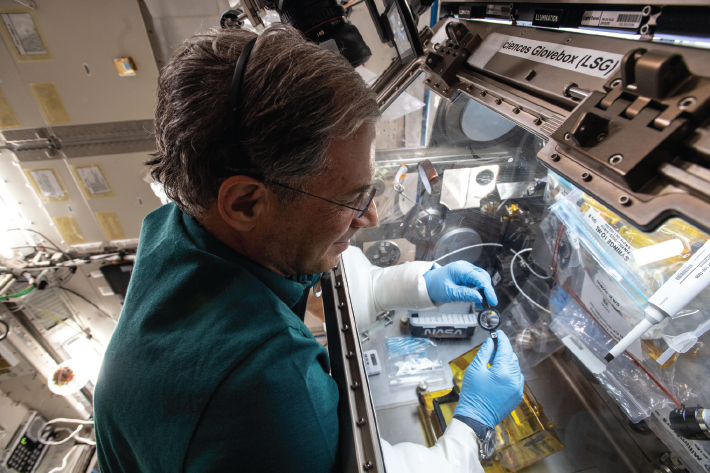
The Nano Bible, which is the size of a grain of sugar, has all 1.2 million letters of the Bible engraved on its gold-plated silicon layer and can only be read using a microscope capable of 10,000 times magnification. “The Bible is the oldest and most important text for the Jewish people and one of the most important for the entire world,” Prof. Sivan said. “It’s a cornerstone of human culture. Taken into space, the Nano Bible connects distance and time, the past and the future, and ancient human culture with modern technology.”
Understanding of the universe in which we live
Another breakthrough Technion experiment – Gamma-ray Burst Localizing Instrument (GALI) – to be tested at the ISS – was developed by Prof. Ehud Behar, Dean of the Faculty of Physics, faculty member Prof. Shlomit Tarem, and their research team. It is believed that gamma-ray bursts occur when stars explode or neutron stars merge, but this understanding has yet to be confirmed by observing multiple events.
The GALI gamma-ray detector invented at the Faculty of Physics makes it possible to precisely detect where these explosions occur in space, allowing astronomers to direct telescopes to the event to study the connection between the gamma-ray burst and other events, like gravitational waves, helping us gain a deeper understanding of the universe in which we live.