
How does our brain process and store movement? Technion scientists solve the mystery, with implications for multiple diseases as well as machine learning
From the moment we are born, we interact with the world through movement. We move our lips to smile or to talk. We extend our hand to touch. We move our eyes to see. We wiggle, we walk, we gesture, we dance. How does our brain remember this wide range of motions? How does it learn new ones? How does it make the calculations necessary for us to grab a glass of water without spilling or dropping it?
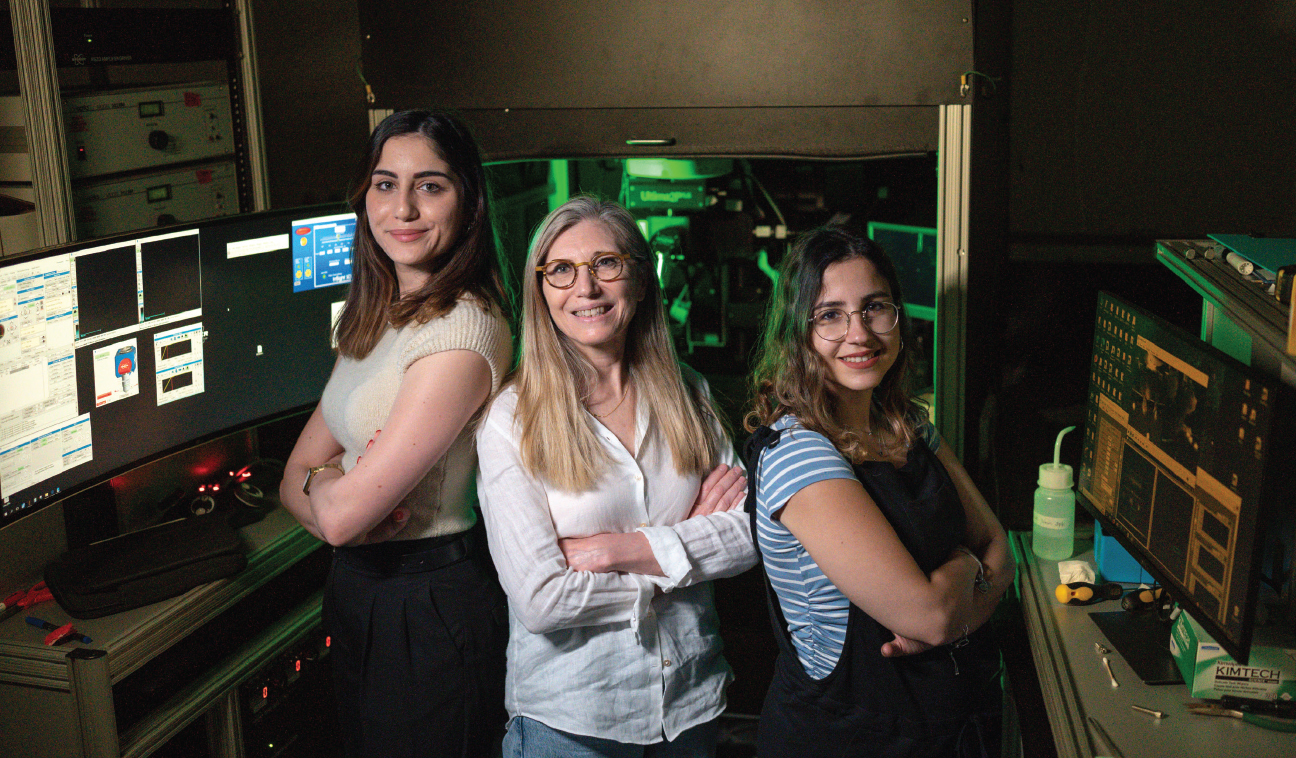
Prof. Jackie Schiller from the Ruth and Bruce Rappaport Faculty of Medicine and her team examined the brain at a single-neuron level to shed light on this mystery. They found that computation happens not just in the interaction between neurons (nerve cells), but within each individual neuron. Each of these cells, it turns out, is not a simple switch, but a complicated calculating machine.
This discovery, published recently in the prestigious academic journal Science, promises to change our understanding of how the brain works, and a better understanding of conditions ranging from Parkinson’s disease to autism. And if that isn’t enough, these same findings are expected to advance machine learning, offering inspiration for new architectures.
Learning and remembering movement
Movement is controlled by the primary motor cortex of the brain. In this area, researchers are able to pinpoint exactly which neuron(s) fire at any given moment to produce the movement we see. Prof. Schiller’s team was the first to get even closer, examining the activity not of the whole neuron as a single unit, but of its parts.
Every neuron has branched extensions called dendrites. These dendrites are in close contact with the terminals (called axons) of other nerve cells, allowing the communication between them. A signal travels from the dendrites to the cell body, and transferred onward through the axon. The number and structure of dendrites varies greatly between nerve cells, like the crown of one tree differs from the crown of another.
Prof. Schiller’s team focused on the largest pyramidal neurons of the cortex. These cells, known to be heavily involved in movement, have a large dendritic tree, with many branches, sub-branches, and sub-sub-branches. The team discovered that these branches do not merely pass information onward.
Each sub-sub-branch performs a calculation on the information it receives and passes the result to the bigger sub-branch. The sub-branch than performs a calculation on the information received from all its subsidiaries and passes that on. Multiple dendritic branchlets can interact with one another to amplify their combined computational product.
The result is a complex calculation performed within each individual neuron. For the first time, Prof. Schiller’s team showed that the neuron is compartmentalized, and that its branches perform calculations independently.
“We used to think of each neuron as a sort of whistle, which either toots, or doesn’t,” Prof. Schiller explains. “Instead, we are looking at a piano. Its keys can be struck simultaneously, or in sequence, producing an infinite number of different tunes.”
This complex symphony playing in our brains is what enables us to learn and perform infinite different, complex and precise movements.
Designing complex neural networks
Multiple neurodegenerative and neurodevelopmental disorders are likely to be linked to alterations in the neuron’s ability to process data. In Parkinson’s disease, it has been observed that the dendritic tree loses computational power. In light of the new discoveries by the Technion team, we understand that as a result of that loss, the neuron’s ability to perform parallel computation is reduced.
In autism, it appears that the excitability of the dendritic branches is altered, resulting in the numerous effects associated with the condition. The novel understanding of how neurons work opens new research pathways to these and other disorders, with the hope of alleviating them.
These same findings can also serve as an inspiration for the machine learning community. Deep neural networks, as their name suggests, attempt to create software that learns and functions similar to a human brain. Although their advances constantly make the news, these networks are primitive compared to a living brain. A better understanding of how our brain actually works can help in designing more complex neural networks, enabling them to perform more complex tasks.
This study was led by two of Prof. Schiller’s M.D.-Ph.D. candidate students Yara Otor and Shay Achvat. The team also included postdoctoral fellow Nate Cermak (now a neuroengineer), Ph.D. student Hadas Benisty, and three collaborators: Profs. Omri Barak, Yitzhak Schiller and Alon Poleg-Polsky.
The study was partially supported by the Israeli Science Foundation, Prince Funds, the Rappaport Foundation and the Zuckerman Postdoctoral Fellowship.
We used to think of each neuron as a sort of whistle, which either toots, or doesn’t… Instead, we are looking at a piano. Its keys can be struck simultaneously, or in sequence, producing an infinite number of different tunes.