
Through its Human Health Initiative, the Technion will invest in interdisciplinary research projects to tackle key challenges of the 21st century; the Technion-Rambam Center for Artificial Intelligence in Healthcare will facilitate real-time precision diagnosis and treatment.
Access to technology and improved infrastructure have led to unprecedented levels of economic prosperity across the globe. Yet, such developments have only gone so far to improve the state of human health, as evident by the recent pandemic.
To meaningfully address this challenge, the Technion launched its Human Health Initiative (THHI) last year at the behest of President Prof. Uri Sivan. The goal of THHI is to bolster interdisciplinary research in the fields of health and medicine to discover innovative breakthroughs that could solve some of humanity’s greatest health challenges.
The idea is to build a bridge between medicine and life sciences, exact sciences, engineering, data science, and design.
Building a bridgeamong faculties
According to the President, “the idea is to build a bridge between medicine and life sciences, exact sciences, engineering, data science, and design. The initiative brings together researchers from different faculties on the premise that removing boundaries between faculties and disciplines is essential to preserving the Technion’s world-class status and to meeting the challenges of the 21st century.”
The Technion boasts many multidisciplinary research projects that meet the criteria of the THHI initiative, so an internal competition was organized to select the projects that would receive funding to contribute to this important mission. Out of the 13 teams that submitted proposals, three were selected. One group is harnessing synthetic biology and ultra-low power electronics to monitor signals in the gastrointestinal tract, enabling real-time focused molecular analysis; another is developing an MRI-based technique for non-invasive clinical diagnosis and treatment of disease in real-time; and the third group proposed the establishment of the Technion-Rambam Center for Artificial Intelligence in Healthcare (CAIH), promoting the development of AI technologies for the betterment of patient care and medical outcomes.
At the forefront of AImedical applications
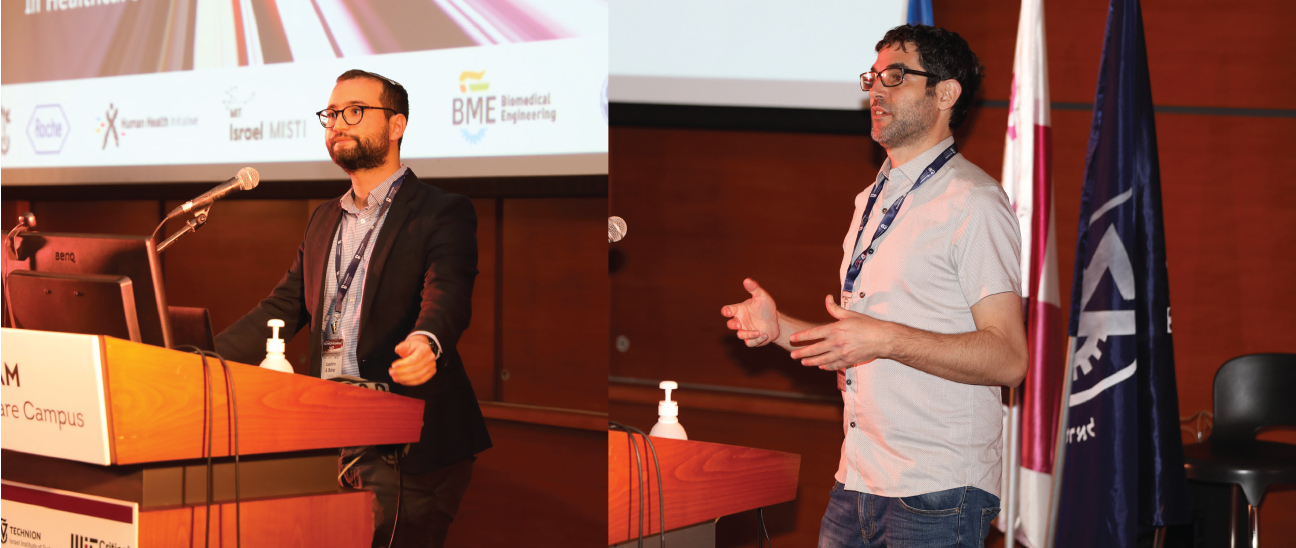
The CAIH, located at Rambam Health Care Campus, is the brainchild of the Technion and Rambam Health Care Campus in Haifa. The first joint academic-medical AI center in Israel, it is also one of the first in the world to develop advanced systems to analyze patients’ conditions. The CAIH is led by a team of leading researchers across various Biomedical fields, including: Prof. Joachim Behar of the Faculty of Biomedial Engineering, Prof. Uri Shalit of the Faculty of Industrial Engineering and Management; Prof. Shie Mannor of the Andrew and Erna Viterbi Faculty of Electrical and Computer Engineering; Prof. Shai Shenn-Orr of the Ruth and Bruce Rappaport Faculty of Medicine, and others.
The focus of the Center will be on developing tools that can dramatically improve diagnosis and clinical outcomes with AI technology, aiding physicians in selecting the most appropriate and precise course of treatment for patients in real time. The researchers will have a vast database of medical information at their disposal that will be the basis for developing their solutions.
According to Prof. Shalit, “data scientists need a large amount of curated data… And, the clinical world needs experts who will analyze this data and derive useful insights from it. For us as scientists, this is a significant means of influencing human wellbeing.”