
A Technion expedition has discovered that populations of oxygen-producing bacteria in the ocean can suffer viral epidemics, which could impact these tiny yet environmentally important creatures
At least half of the Earth’s oxygen production comes from oceans, which cover 70% of the planet’s surface. Yet, much remains unknown about the oceans and the organisms that live in them. The work of Prof. Debbie Lindell and her team at the Faculty of Biology helps shed light on these tiny creatures.
A major group of oxygen-producing, single-cell “plants” that live in the ocean are called “cyanobacteria” (formerly known as blue-green algae). Like plants that grow in our garden, cyanobacteria perform photosynthesis; they trap CO2 to produce oxygen and organic compounds (e.g., fats, sugars). Like any other living organism, sometimes cyanobacteria get infected by viruses.
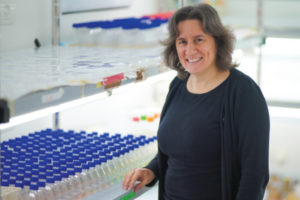
A team headed by Prof. Lindell has found that just like humans, cyanobacteria can experience viral epidemics that significantly affect their population. These findings were recently published in the academic journal Nature Microbiology.
A hotspot of viral activity
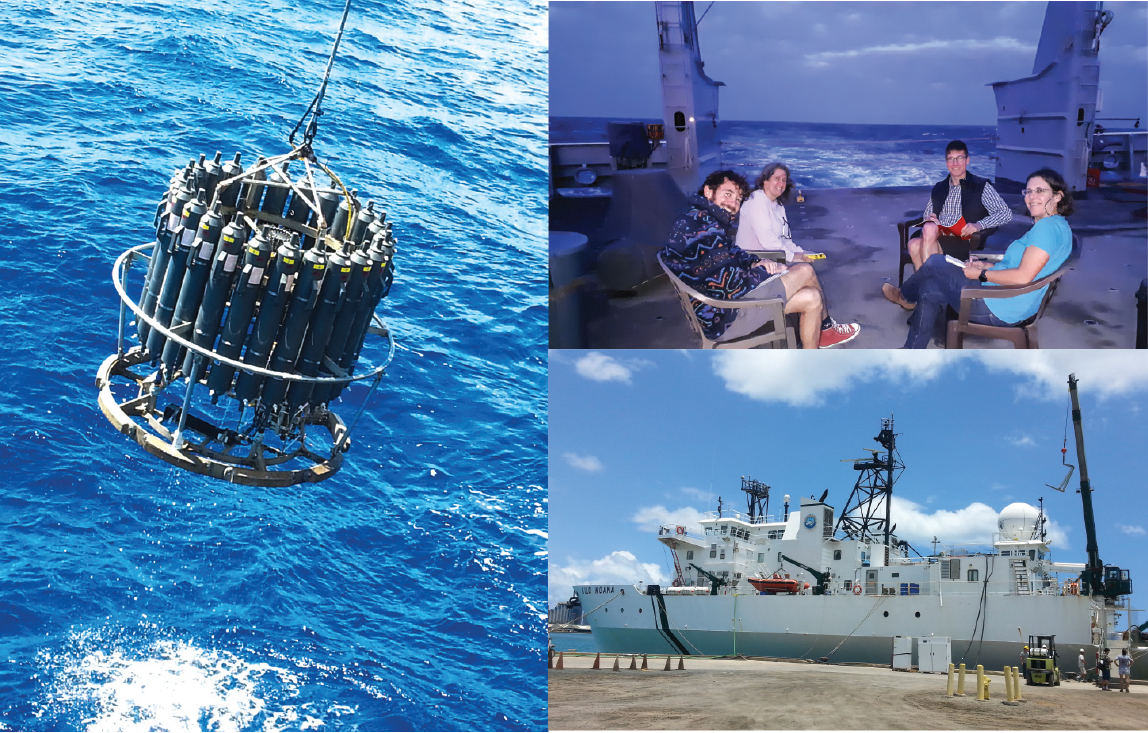
Dr. Michael Carlson, a postdoctoral fellow in Prof. Lindell’s lab, sailed along the Pacific Ocean to study the populations of two common cyanobacteria: Prochlorococcus and Synechococcus. The two species live in different latitudes; Prochlorococcus live in warmer but less nutrient-rich waters, while Synechococcus prefer colder and more nutrient-rich latitudes. In the area in between, both thrive, creating a hotspot, or “cyanobacteria-city.”
This hotspot, it turns out, is also a hotspot of viral activity. Much like a bustling city sees considerably more viral infection than a remote village, in the cyanobacteria-city, more cyanobacteria are infected. Normally three times more, as Prof. Lindell and Dr. Carlson observed in 2015 and 2016. But when the team arrived at the same location in 2017, they found that infection rates were 10 times higher than usual, and that the Prochlorococcus population in the hotspot significantly declined. In 2017, the Prochlorococcus population declined at 17 degrees (Celsius), when normally these cyanobacteria are comfortable at temperatures as low as 12 degrees. The Prochlorococcus, in short, suffered a virus outbreak, destroying a high percentage of them.
Up until now, we did not know that viral infection could have such a dramatic effect on cyanobacterial populations.
Up until now, we did not know that viral infection could have such a dramatic effect on cyanobacterial populations; we only knew that viruses infected and destroyed cyanobacteria. But among the other factors affecting the size of the cyanobacterial population (being eaten by bigger organisms, water temperature, nutrient availability, to name a few), viral infection was not known to be significant. The findings of Prof. Lindell’s group are comparable to suddenly discovering the deadly Spanish influenza, after having known only about the common flu for years.
Oceanic pandemics?
Prof. Lindell’s discovery was made possible by technologies developed earlier by her lab. The group devised novel methods to quantify the groups of viruses that infect the cyanobacteria and the extent to which these viruses infect their hosts. Sailing northwards from Hawaii, the group was able to sample the same locations over three years at high spatial resolution and discover the 2017 infection event. Satellite data on water temperature and chlorophyll concentration allowed the group to infer that the phenomenon they observed had spread across the North Pacific Ocean, and was not limited to the single cruise track they sailed along.
While the Prochlorococcus population suffered in 2017, the population of Synechococcus was less affected. In fact, it increased in size and was able to spread, benefiting from weakened competition. Prof. Lindell and her team members believe it was due to the Synechococcus reproducing faster; the viruses killed Prochlorococcus before they were able to reproduce but couldn’t do the same to Synechococcus.
It seems that the more we know about these tiny creatures, the better our chances of protecting the ocean and the environment will be.
This study was led by Prof. Lindell and Dr. Carlson, in collaboration with researchers from the University of Washington and the University of Hawaii. It was supported by the European Research Council (ERC) and the Simons Foundation as part of the Simons Collaboration on Ocean Processes and Ecology (SCOPE). Dr. Carlson was supported by a Fulbright Postdoctoral Fellowship.